By Jesse Sevilla
Kitting and labeling comes up for all kinds of reasons. A retailer wants a multipack. You’re running a promo bundle. A distributor needs something display-ready. Or at some point the math just works. Before you hand that work off to a 3PL, there are five things worth knowing.
What You’ll Learn:
- What kitting and labeling services actually cover and where the complexity hides
- Why food and beverage brands face different compliance requirements than general CPG
- How to evaluate whether a 3PL’s kitting operation is actually in-house
- What a bill of materials has to do with your labeling accuracy
- Why integrated fulfillment under one roof changes the math on outsourcing
1. Kitting and Labeling Services Cover More Ground Than Most Brands Expect
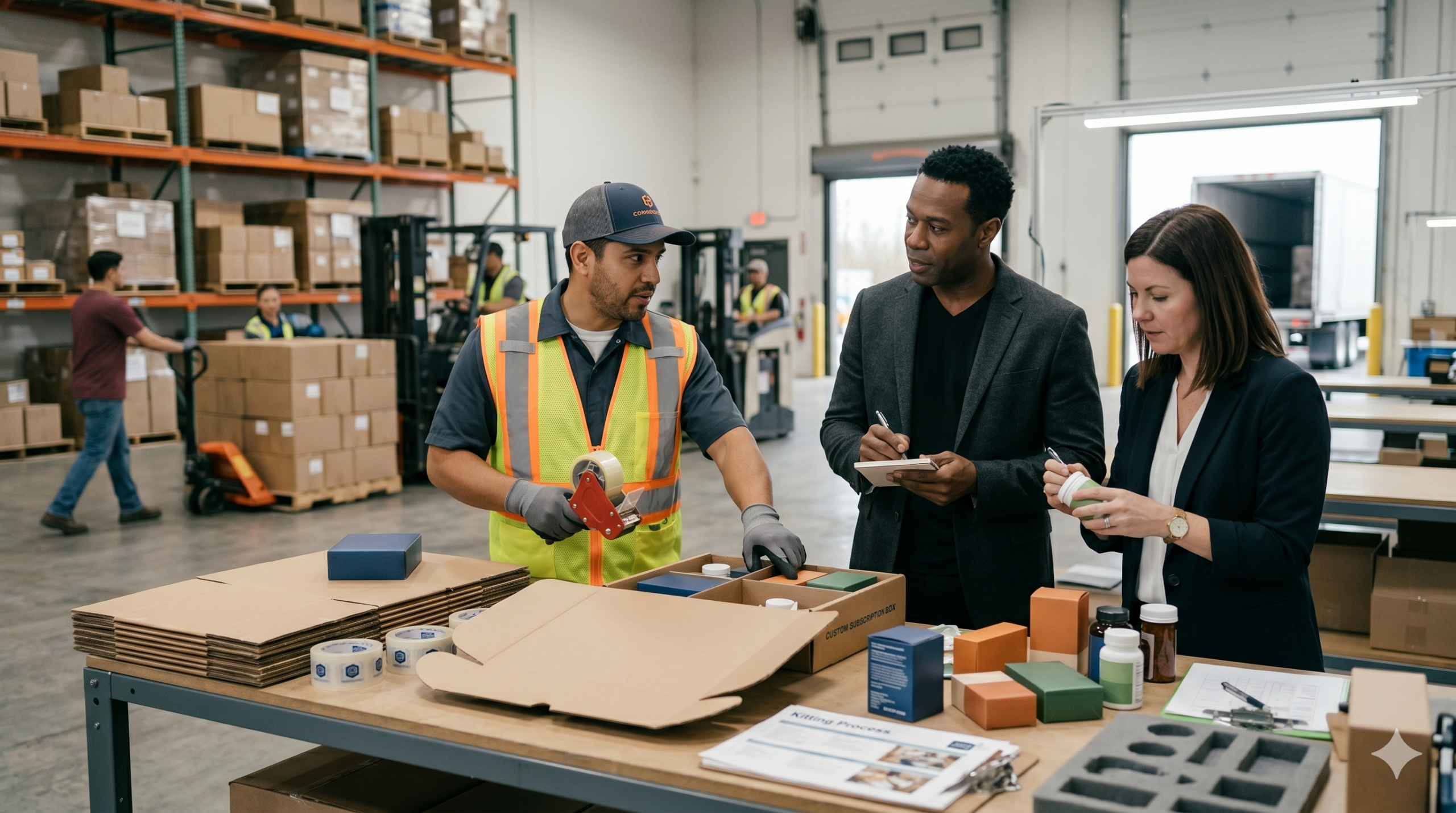
On paper, kitting is pretty simple. You’re combining individual products into a single sellable unit and putting the right label on it. But once you get into it, a single kitting project for a food or beverage brand can involve receiving and inspecting components, managing a bill of materials, lot tracking across every ingredient, barcode verification, and building out retailer-specific case and pallet configurations. Each one of those steps is a place where things can go sideways.
The brands that end up in trouble are usually the ones that treat kitting like a simple labor job instead of a real logistics operation. When a label goes out wrong (wrong lot code, missing allergen info, a barcode that won’t scan at the retailer’s DC), it almost never comes down to one person making a mistake. It comes down to a process that wasn’t built to catch the error before the product shipped.
States Tip
Before signing with any 3PL for kitting and labeling services, ask them to walk you through their QC process from component intake to finished unit release. If they can’t walk you through it in detail, that tells you everything you need to know.
2. Food and Beverage Compliance Is Not the Same as General CPG
A 3PL that kits gift sets for a personal care brand is operating in a completely different world than one handling food and beverage. The margin for error is smaller because the consequences are bigger. Undeclared allergens are the leading cause of FDA food recalls, accounting for nearly half of all incidents in early 2025. A wrong label on a kitted multipack isn’t just a chargeback from the retailer. It can turn into a recall.
Food-grade facilities for this kind of work need GMP-certified facilities at a minimum, with lot tracking and traceability running through the WMS. If your products are organic, it goes even further. Any 3PL doing value-added work on your organic SKUs needs to hold its own USDA NOP organic certification. Your certification doesn’t cover their operation. Use the table below as a starting checklist when you’re evaluating partners.
| What to Ask | What to Look For |
|---|---|
| What food-grade certifications does the facility hold? | GMP is the baseline. BRC is required by many major retailers. Organic certification matters if your SKUs carry that label and the 3PL is doing any value-added work on open product. |
| Does lot tracking run through the WMS? | Manual lot tracking isn’t lot tracking. You need a system that picks up component lots at intake and follows them all the way through to the finished unit. |
| How does the facility handle allergen separation? | If your product shares a kitting line with anything containing top allergens, you need documented cleaning procedures and physical separation protocols on file. |
| What is their audit history? | A clean track record across multiple certification cycles means a lot more than a first-year certificate. Ask to see the results, not just proof they’re currently certified. |
3. In-House Does Not Always Mean What You Think
A lot of 3PLs have kitting and labeling services listed on their website. Fewer of them are actually running those operations inside their own building. Some subcontract the kitting work to a co-packer and handle fulfillment themselves. Others bring in temp labor that rotates through without ever really learning your specs. Either way, you’ve got a handoff, and every handoff is a spot where your BOM, your label requirements, and your quality standards have to travel between people who may not be on the same page.
When kitting is happening at a different facility than fulfillment, you’re also paying freight to move product between the two. For food and beverage brands working with tight shelf-life windows, that extra leg isn’t just a cost problem. It’s a timing problem. The Contract Packaging Association has noted that secondary packaging is a growing share of outsourced work, and a big reason is that brands are trying to pull things together rather than spread them further apart.
States Tip
Ask point blank: “Is kitting done by your own employees, in your own facility, using your own WMS?” All three matter. If any answer is no, you’re looking at a subcontracting setup, not a true integrated operation.
4. Your Bill of Materials Drives Everything Downstream
A bill of materials (BOM) is the document that tells your 3PL exactly what goes into each kit: which components, how many, what the label looks like, what goes in the outer carton, and in what order everything gets assembled. It sounds like paperwork, but it’s really the thing that determines whether your kitting and labeling operation runs clean or turns into a rework problem.
For food and beverage, the BOM also has to account for lot rotation. If you’re kitting three flavors of a beverage into a mixed multipack, the WMS needs to pull by FEFO (first expired, first out) and keep a record of which lot numbers ended up in each finished kit. Without that chain of custody, a recall gets a lot more complicated. You can’t pull the right units if you don’t know which kits they’re in.
A solid BOM covers more than most brands think to include upfront. Before your first kitting run, make sure yours has:
- Component SKUs and quantities: Every item going into the kit, with exact counts per finished unit
- Label specifications: Artwork file, barcode format, placement coordinates, and any retailer-specific requirements
- Packaging materials: Outer carton, shrink wrap, inserts, and any branded components with their own SKUs
- Assembly sequence: The order of operations, especially if certain steps require inspection before moving on
- Lot rotation rules: FEFO or FIFO instructions so the WMS pulls components in the right order
A good 3PL will ask for your BOM before the first run and flag anything that’s missing before assembly starts, not halfway through it.

5. Integrated Services Change the Economics of Outsourcing
The real value of outsourcing kitting and labeling services shows up when that work is happening alongside warehousing, packaging, and transportation all under one roof. When your product goes from receiving to kitting to outbound without leaving the building, you cut out the freight between steps, the back-and-forth between vendors, and the gaps in documentation that open up every time product changes hands.
For food and beverage brands with tight promotional windows, that kind of setup also means faster turnaround. A four-week lead time for a club store promotion is very doable when your 3PL is pulling components from the same warehouse where they’re already sitting, kitting them on-site, and routing finished units straight into outbound transportation. That same job with two or three vendors in the chain almost never hits the window cleanly.
The case for integrated packaging services really comes down to this: every vendor you add between production and shelf is another relationship to manage, another invoice, and another place your specs can get lost. Pulling kitting and labeling under the same roof as the rest of your 3PL operation takes those layers out and puts accountability in one place.
States Tip
When you’re evaluating 3PLs, ask whether their WMS handles both inventory and kitting workflow in the same system. Separate systems for warehousing and assembly create the same headaches as separate vendors.
Checking the Boxes
Outsourcing kitting and labeling makes sense for most growing food and beverage brands. Where it gets tricky is when the 3PL you pick isn’t actually set up to handle it. Food-grade certifications, a real in-house operation, WMS-driven lot tracking, and integrated fulfillment aren’t extras. They’re what the job requires. Get those right and you’ve got a partner that can protect your brand and keep your program running. Skip them and you’ll find out why they matter the hard way.
For CPG food and beverage brands distributing across Southern California and Phoenix, States Logistics Services, Inc. operates 13 facilities with GMP, BRC, and Organic certifications alongside integrated kitting, labeling, and packaging services under one roof.
Frequently Asked Questions
What is the difference between kitting and co-packing?
Kitting combines finished, individual SKUs into a new sellable unit without altering the products themselves. Co-packing typically involves production-level work, such as filling, sealing, or manufacturing the product before packaging. A 3PL offering kitting and labeling services is assembling and labeling components you’ve already produced, not manufacturing them.
Do I need a food-grade certified facility for kitting and labeling?
Yes, if your products are food or beverage. GMP certification is the baseline requirement for facilities handling food products. BRC certification is required by many major retailers before they’ll accept inbound shipments. If your SKUs carry organic certification, the facility performing kitting and labeling on open product must also hold USDA NOP organic certification.
How does lot tracking work in a kitting operation?
Lot tracking in kitting means the WMS records which component lot numbers went into each finished kit at the time of assembly. This gives you a full chain of custody from component intake through outbound shipment. For food and beverage brands, this documentation is essential for managing recalls and satisfying retailer compliance requirements.
What should a bill of materials include for a kitting project?
A complete BOM for a kitting project covers component SKUs and quantities, label specifications including barcode format and placement, packaging materials, assembly sequence, and any retailer-specific requirements such as case configuration or pallet labeling. Your 3PL should review and confirm the BOM before the first assembly run, not during it.
What are the risks of using a 3PL that subcontracts its kitting?
When kitting happens at a facility separate from your fulfillment operation, your product changes hands at least once more than it needs to. Each handoff introduces risk: transit time, documentation gaps, and a second set of workers who may not be trained to your label specs or quality standards. For food and beverage brands, that extra handling also adds shelf-life risk and makes traceability harder to maintain across the full chain.
How do I know if a 3PL’s kitting operation is truly in-house?
Ask three specific questions: Are kitting services performed by the 3PL’s own employees? Does kitting happen inside the same facility where your inventory is stored? Does the same WMS manage both inventory and kitting workflow? If any answer is no, you have a subcontracting arrangement. An integrated operation means all three answers are yes and your product never leaves the building until it ships to your customer or retailer.